Archivarix Retrace - Find where a picture came from, using open sources.
Pictures on the web outlive their captions. A photo gets re-saved, cropped, passed off as new, moved to another city or another year. Checking that kind of story by hand takes time: you have to hunt for copies, compare dates and work out what the frame actually shows. Retrace does that work for you and shows what every conclusion rests on.
Retrace is a new Archivarix service for tracing where an image came from. You give it a photo, a GIF or a short video, and it looks for the same image on the open web and puts together a report: where else the picture appears, when it first showed up, what can be seen in the frame itself, and where the shot was most likely taken.
How to check a picture
Paste a link to an image, drag a file onto the page, or press Ctrl+V if the picture is already on your clipboard. On a phone you can take a photo right away or pick one from the gallery, and on Android an installed Retrace shows up in the system Share menu. A YouTube link works too: Retrace checks the video's thumbnail and looks for re-uploads of the same video.
If you have the original file, use it. A screenshot or a re-saved copy loses details the original keeps: when the photo was taken, where, and with what camera.
What the report shows
At the top is the answer card: who is in the picture, where it was taken, and what the picture is. Next to it, the report says what the conclusion stands on: the file matches a copy that was found, several independent sources say the same thing, or there is a single source with nothing to back it up.
The details follow. Earlier copies of the picture, with links to the pages that carry them. The date it first appeared, when the sources allow naming one. A place on the map, when the frame gives enough to pin it down, together with how precise that place is. And whatever the file itself still carries.
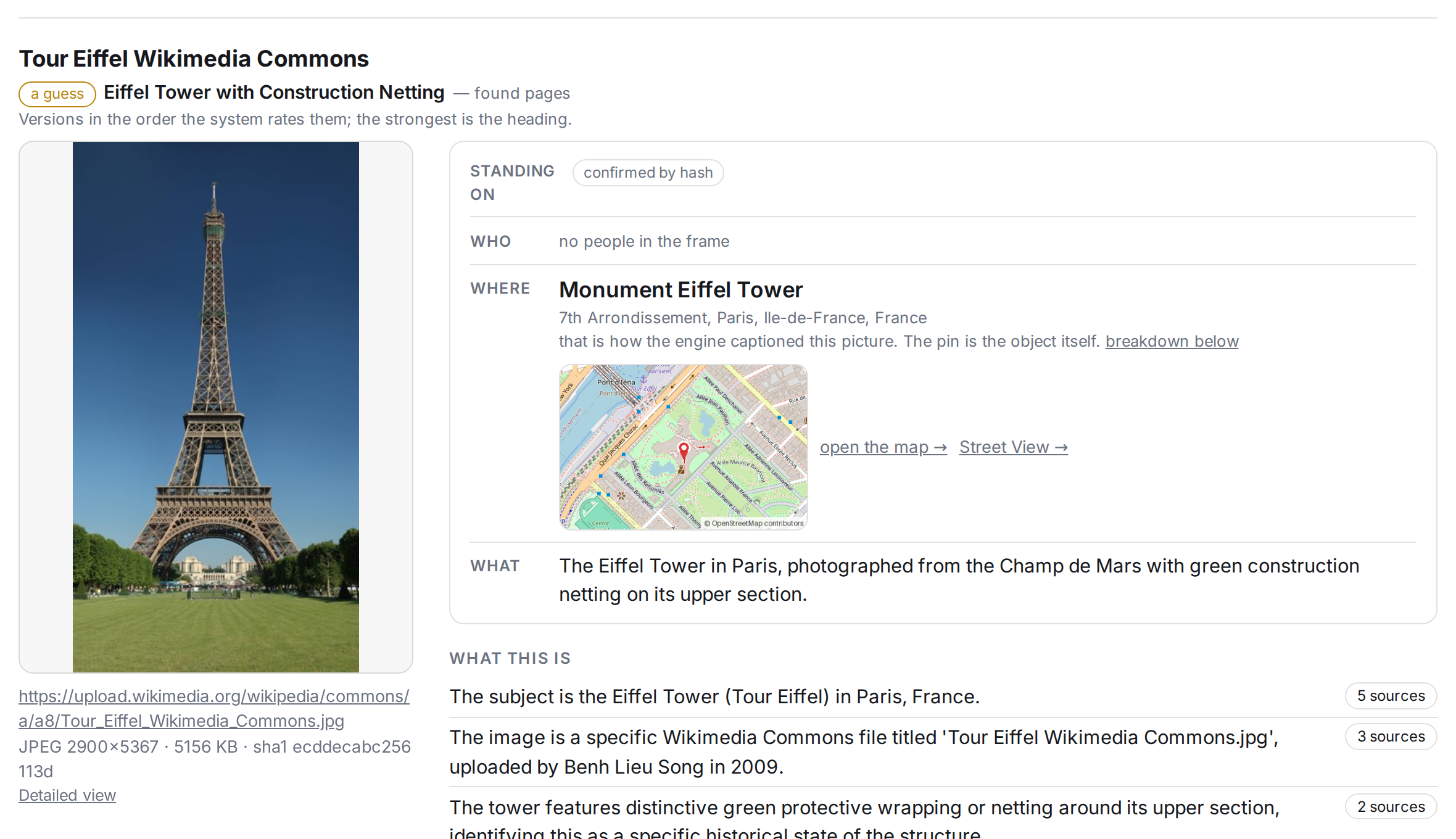
For example, for a well-known photo of the Eiffel Tower from Wikimedia Commons, Retrace found more than 30 exact copies on different sites, worked out that the shot was taken from the Champ de Mars, and showed that the picture was online no later than February 2008.
Every conclusion can be checked
Retrace does not ask you to take its word for anything. Every finding links to the page it came from, so you can open it yourself. The report keeps apart what was measured, what several sources agree on, and what rests on a single source. When nothing could be found, the report says so.
How Retrace finds people
Retrace finds people the same way it finds everything else: through open sources. When pages that carry the same picture say who is in it, in a profile or channel name, a caption, tags, or a watermark or nickname in the frame, the report shows that name next to the link it came from. This is how it finds bloggers, models, artists and other people whose pictures are published online. Retrace does not use biometrics: a name always comes from a page you can open, never from a face.
Our own AI model
The frame is read by our own model running on our own servers, so explicit pictures are not refused or blurred. Cloud AI services usually won't describe them, and Google Lens filters out many adult results. Uploaded files are not passed to outside AI services and are not used to train models.
A missing finding proves nothing: the web is incomplete and archives have gaps. Read a report as a starting point for your own checking.
One account for every Archivarix service
Along with Retrace, we have merged our accounts. One Archivarix account now works across Tube Search, Echo and Retrace. Sign in to one service, and when you move to another you are already signed in, with no second login. Your data stays separate: your Retrace checks live only in Retrace.
There is one subscription too. A Plus or Pro plan raises the limits in every service at once, and Echo stays a free bonus for any account.
Plans
Without an account you get a few checks a day, and a free account gives you more. Paid plans raise the daily limit and keep a history of your checks. The exact numbers and a side-by-side comparison are on the pricing page, and the full walkthrough is in the guide.
Six languages
The interface comes in six languages: English, Russian, Spanish, German, Portuguese and French. The report is written in the language you choose. There is a light and a dark theme, and the service is easy to use on a phone.
Try it: retrace.archivarix.net
The use of article materials is allowed only if the link to the source is posted: https://archivarix.com/en/blog/retrace/

Retrace is a new Archivarix service for tracing where an image came from. You give it a photo, a GIF or a short video, and it looks for the same image on the open web and puts together a report: where…
Hi everyone,
To celebrate our anniversary, we’re bringing back our best offer of the year: up to 100% bonus credit when you add funds. We only offer a bonus this big on our anniversary — once a year.…
Tube Search now has a section of free YouTube tools. These are small utilities that solve specific everyday tasks: stepping through a video frame by frame, extracting hidden tags, checking whether a c…
You found the video you needed on YouTube, but you do not want to watch the whole thing just for a couple of lines. Or you need the text of a lecture to translate it, quote it, or simply skim through …
Open any article from a decade ago and click through the links in it. There is a good chance that some of them lead nowhere. Instead of the page you wanted, you get a 404 error, a parked domain advert…
The web keeps falling apart. Pages go offline, accounts get deleted, papers slip behind paywalls, projects shut down. Usually a copy survives somewhere, in the Wayback Machine, archive.today, Common C…
When you find a deleted YouTube video through Tube Search, you typically get metadata: a title, description, upload date, and sometimes subtitles. That is already useful. But reading through raw subti…
Tube Search is a search engine for archived YouTube data. The service aggregates information from multiple public sources: the Wayback Machine (Internet Archive), Common Crawl, and various collected Y…
Over time, external links in WordPress posts inevitably break, pages get deleted, domains expire, videos become unavailable. Checking hundreds or thousands of links manually is impractical. Archivarix…
One trillion saved pages. Over 99 petabytes of data. Hundreds of crawls running simultaneously every day. Behind these numbers lies a question that everyone who professionally works with web archives …